
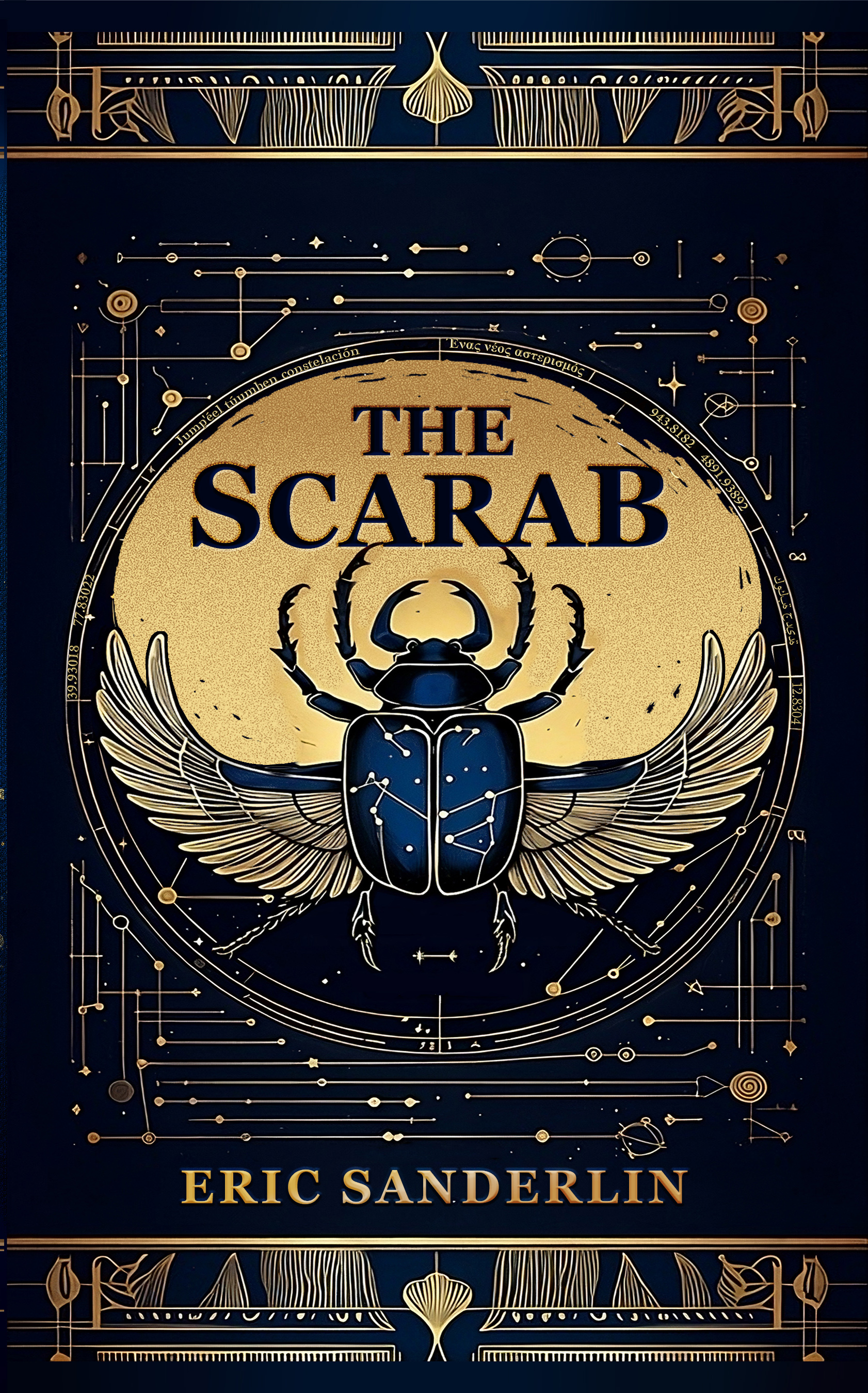
Available as a $10.00 Kindle ebook or a $35.00 collector's hardback — 40–60% of gross profits fund the Nereidonian Heritage Initiative.
Available via Nereidonia Press / IngramSpark
The Scarab
An Alexandrian slave with no family and nothing left to lose joins forces with a Phoenician captain and a Roman navigator of suspicious origin, embarking on a crossing that should be impossible. The trio arrives in the Antilles Isles at a pivotal moment — the fledgling Nereidonian Civilization has just been discovered by an ever-expanding, ever-hungry Roman Empire. Backed into the ultimate corner, our protagonist does everything he can to save a home he has only just found.
| Time Period | 312 CE — Late Roman Empire / Ptolemaic Egypt |
| Themes | Defiance, cultural preservation, the threat of imperialist expansion, identity under subjugation, chosen home versus birthright |
| Referenced Cultures | Arawak, Late-Ptolemaic Egyptian, Roman, Phoenician, Hebrew |
| Recommended If You Enjoy | Dune, The Hobbit, Master and Commander |
| Benefitting Partner | The Nubia Museum, Aswan, Egypt |
Appears in These Reading Pathways
Read Chapter One — Excerpt
Far off in the deserts of Egypt, the city of Alexandria rose from the sands. A testament to human ingenuity, the streets of the city bustled and teemed with activity. Merchants shouted in dozens of languages that all muddled together into an overwhelming din. Shoppers and workers pushed their ways through the crowds as they sought out the valuable and foreign foods, spices, and textiles that these merchants had brought from across the Sahara. Stoic towers and opulent palaces decorated the horizon line of the city, but behind the glamorous facade lay a darker truth. The city of Alexandria, like all cities in Egypt during the reign of the Pharaoh Maximinus Daza, was constructed by slaves. Hundreds. Thousands. The bodies of these men and women formed the foundation and bedrock of the grand temples and gathering spaces where Alexandrians went about their day to day lives. If one were to look closely, they could perhaps see the fingerprints of these hidden architects. Initials carved in a stone at the base of a temple, or a drinking vessel left atop a towering structure never to be recovered. These men and women of all ages, races and walks of life had been collected by Maximinus Daza and his forces for the sole purpose of servitude to the Egyptian Empire. And it was in the very heart of the great city of Alexandria that a crowd of these assembled servants began to grow.
Amid the clamor of life and activity stood a man named Khafra. He was a slave, with deep-set eyes and a strong jawline, his skin darkened by the unrelenting sun of Egypt. His muscular arms, tanned and sinewy, were the result of long hours of hard labor in the Alexandria docks and high up in the lofts of Cairo temples as a lead engineer. A rough shadow traced his jawline, the stubble of a man who was far too busy to attend to things like self care. Despite his slave status, Khafra had a fierce and unyielding spirit, with a sharp mind and a keen sense of observation. His experience as a slave had made him wise and cunning, and he knew how to navigate the treacherous waters of Alexandria's social hierarchy. Khafra's eyes scanned the crowd, taking in every detail of the Royal Overseer's announcements as they began. He knew that the Overseer's words can shape the fate of the city and its people, and he was determined to stay prepared for anything.
At last, the Overseer arrived along with his entourage of guards and priestesses. A squat and homely man that otherwise would not receive a second glance on the streets of Alexandria, the Overseer huffed up the stairs of the raised stone platform from which he would address his subordinates. Upon reaching the pulpit atop the stone platform, the Overseer was forced to take a moment to recover his breath before speaking. "Loyal subjects of Alexandria, hear me!" the Overseer began. "The might of our armies continues to grow, and with it, our glorious empire spreads its reach further than ever before. The conquest of new lands, the acquisition of new resources, the enslavement of new peoples — all this is thanks to our wise and powerful leaders who guide us to greatness." The crowd of servants and slaves began to stir as they slowly realized why they had been gathered for such an important announcement.
As the Overseer continued his announcements, a lone voice suddenly rose from the back of the crowd. "What about the people of Alexandria?" the man shouted. "What do we get out of your conquests and victories?" The guards moved to silence him, but the man was undeterred. "We're the ones who suffer the consequences of your greed and ambition!" he yelled, his voice shaking with anger. Khafra watched as the heckler, a thin and ragged old man, began to emerge from the throngs of servants gathered in the square. He wondered whether the old man was brave or foolish for standing up against such an overpowering opponent. Probably both, Khafra decided.
The Overseer paused momentarily, allowing the guards' violence to hang in the air and the minds of the servants before continuing. "The spoils of Maximinus Daza's empire are shared with all of those who live under his graces, but the man who speaks out of turn to spite the Pharaoh will have his tongue cut out in return." The Overseer's words hung heavily in the air as he looked out over the silent crowd. Khafra could see the fear and desperation etched on the faces of the servants around him, a stark reminder of the power imbalance that existed between them and their rulers.
Khafra's attention drifted away from the Overseer's words, and he allowed himself to look around at the city he had helped build. The towering obelisks, the massive temples and grand colonnades. All of it seemed to stretch to the sky in a glorious testament to the Pharaoh's might, and yet, Khafra couldn't help but feel a sense of emptiness deep in his gut. He had spent his entire life building these magnificent structures, yet he was still no more than a lowly slave. As his eyes drifted across the rooftops of Alexandria's towers and temples, his eyes settled on one temple in particular. The Temple of Isis. Khafra's mind was consumed by memories of the temple's construction — the hours of labor, the sweat and toil he and his fellow builders had poured into the stone, and the satisfaction of seeing the finished product rise before him. But now, as he looked upon the temple, he could see that the building had been desecrated by Maximinus Daza's men. The once pristine stone was now chipped and cracked, and the intricate carvings that had once adorned the walls were defaced by crude graffiti and the banners of a jealous Pharaoh.
He had heard whispers of a rebellion brewing among the slaves, a glimmer of hope in an otherwise bleak existence. But Khafra knew that any such rebellion would be met with ruthless force, and the chances of success were slim at best. Yet, he couldn't shake the feeling that there had to be more to life than this endless cycle of toil and suffering.
A portion of every purchase supports a real-world partner
Proceeds from The Scarab are allocated to The Nubia Museum in Aswan, Egypt through the Nereidonian Heritage Initiative. View disbursement records →